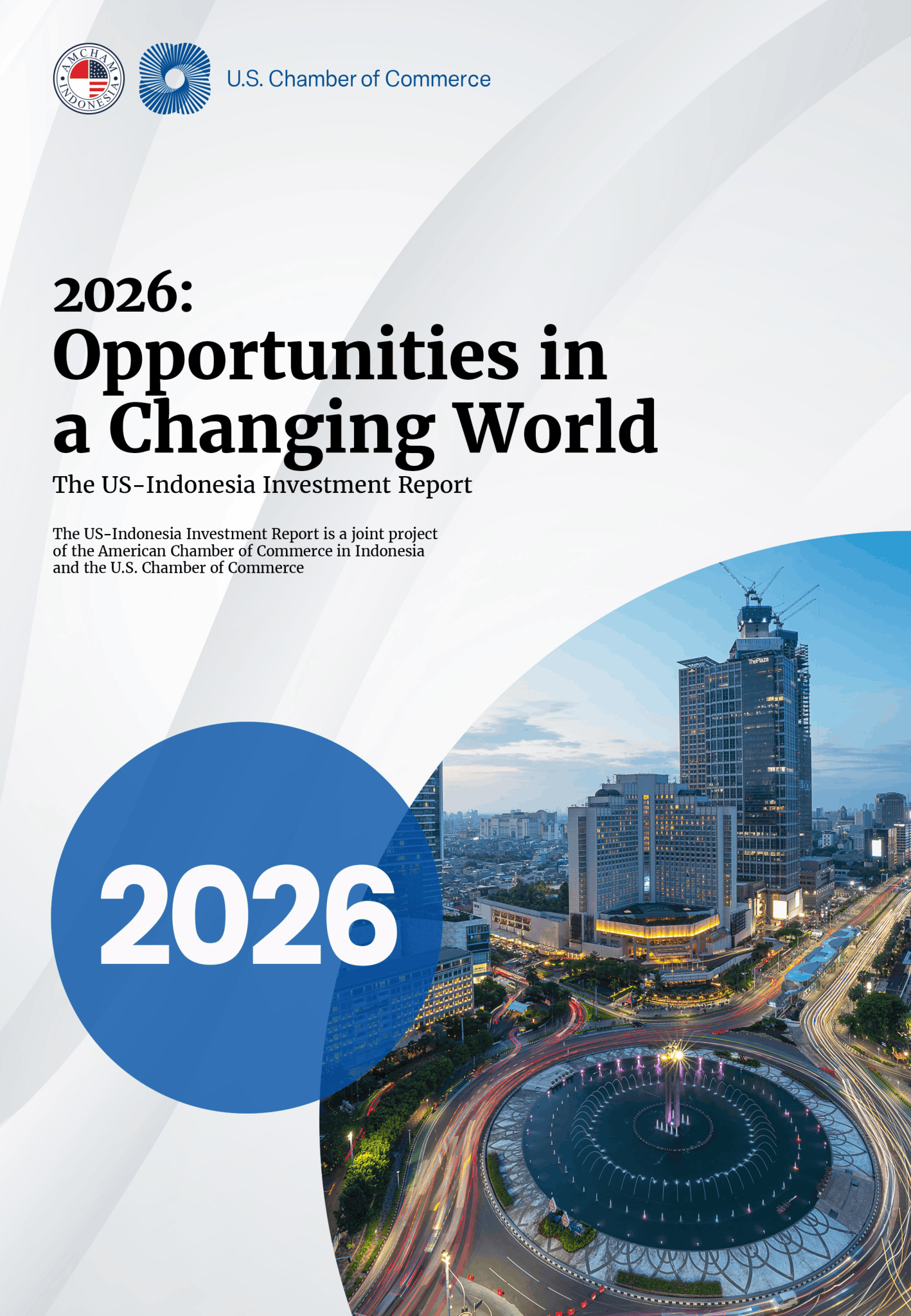













14th Annual US-Indonesia Investment Summit held in Jakarta
The American Chamber of Commerce in Indonesia and the U.S. Chamber of Commerce held the 14th annual US-Indonesia Investment Summit on Oct 6 at the St Regis hotel in Jakarta.
Under the theme “Building Confidence: Strengthening Indonesia's Investment Climate” the Summit brought together senior government officials with major foreign investors to discuss the latest developments in the business climate in Indonesia and prospects for the future.

The event also saw the release of the annual U-Indonesia investment report – 2026 Opportunities in a Changing World– which called for flexibility and openness to investment during a time of global upheaval.
Coordinating Economic Minister Airlangga Hartarto was the event’s keynote speaker." I think investors are quite confident in the Indonesian economy," Airlangga said, pledging to help direct the economy toward higher growth by increasing exports and growing high-quality investment capacity.
AmCham Managing Director Donna Priadi said investors are seeking stability and predictability in policy development but they remain bullish on the country.
“Many American companies have invested in Indonesia and operated here for more than 100 years," Donna said. "In the end, investors will continue to invest in Indonesia because there are so many opportunities, robust growth and a young population."


Trade Minister Budi Santoso, Deputy Bank Indonesia Governor Thomas Djiwandono and Deputy Communications Minister Nezar Patria also spoke at what has become the premier bilateral private sector event of the year for policymakers and US business leaders.
Hashim Djojohadikusumo, thePresidential Special Envoy for Climate and Energy, praised the government’s efforts in sustainability. “For the first time in 40 years, we are self-sufficient in rice,” he said, which is a major basis for future growth.


The chairwoman of the Indonesia Employers Association (Apindo), Shinta Kamdani, called for better quality investment and pointed to the need for policy consistency. She praised US companies for bringing capital, technology, innovation and higher value to the country.
The chief representative of the Organisation for Economic Cooperation and Development (OECD) in Indonesia, Massimo Geloso Grosso, spoke about the country’s ongoing bid to join the OECD, saying that if successful it could help transform the Indonesian economy.
The annual event began in 2013 and is part of Initiative Indonesia, a year-long advocacy project of the U.S. Chamber and AmCham Indonesia.
Labor Protection Bill Passes DPR
The House of Representatives (DPR) passed the Employment Protection Bill into law during a plenary session on Oct 6, less than two months after lawmakers initiated the bill under the orders of the Constitutional Court.
Business has been anxious to see a law that maintains a balance between employers and employees and the government said that goal has been achieved. The final text has yet to be made public.
Manpower Minister Yassierli said during the plenary session that the new law had “harmonized standards that were previously scattered and often caused uncertainties.”
He outlined several key labor protection provisions, starting with guarantees of equal opportunity and fair treatment across all sectors.
“This bill reinforces the principle of nondiscrimination, including in the recruitment process, remuneration, career development and employment relations, so that every worker receives fair and equal treatment in the workplace,” he said.
Yassierli said the law also regulates certain foreign workers and strengthens protections for outsourced workers at state-owned enterprises (SOEs).
“Overall, the government sees the labor protection bill as having reflected a balance between the fundamental rights of workers and the sustainability of the business sector,” Yassierli said.
Several labor groups attended the plenary session and afterward House Deputy Speaker and key presidential aide Sufmi Dasco met with labor unions and said President Prabowo Subianto had fulfilled his promise to pass the law.
The government hopes to finalize the bill before the end of October, following a Constitutional Court ruling in October 2024 that called for a new employment law separate from the Omnibus Job Creation Law within two years.
A draft bill in circulation limits outsourcing to five support service categories and limits fixed-term employment contracts (PKWT) to two years, with up to two one-year extensions.
The legislation also states that the minimum wage formula must be based on recommendations from the National Wage Council through “a transparent process involving the government, employers and workers unions.”
The Indonesia Employers’ Association (Apindo) has urged a balance between business flexibility and worker protection, warning that if the measure favors labor too much it could slow job creation and harm investments.
Related Links:
- https://www.antaranews.com/berita/5775910/pengamat-uu-perlindungan-ketenagakerjaan-pertegas-hak-pekerja
- https://www.bbc.com/indonesia/articles/ck8dzm91rllzo
- https://money.kompas.com/read/2026/10/06/060139826/pengusaha-ruu-ketenagakerjaan-dinilai-terlalu-ketat-bisa-bikin-investor-kabur
- https://www.thejakartapost.com/business/2026/10/06/house-passes-new-manpower-law-touts-it-as-a-gift-to-workers?utm_source=(direct)&utm_medium=channel_regulations
DPR Passes One Data Bill
The House of Representatives (DPR) has passed the One Data Indonesia Bill, establishing a national framework for government data while allowing institutions to retain ownership of physical databases.
The bill was passed on Oct 6 and consists of 20 chapters and 141 articles that strengthen the legal framework previously governed primarily by Presidential Regulation 39/2019.
House Legislative Body (Baleg) Deputy Chairman Sturman Panjaitan said the law establishes common standards, metadata, reference codes and master data to allow different institutions to communicate with one another.
“The standards are singular, the metadata is singular, the reference codes are singular, the master data is singular so that data can communicate from different sources but hold one truth,” Sturman said during the plenary session.
The law establishes National Basic Data (DDN) as a core reference for strategic government decisions, including development planning, fiscal policy and social assistance. It also establishes a One Data Indonesia body reporting to the president.
Under the framework, government institutions can exchange and access data without transferring ownership of their underlying databases. The model is broadly comparable to Estonia’s X-Road, which connects government databases through common standards and data-exchange mechanisms rather than consolidating them into a single database.
The law also provides for public participation through data contributions, reporting data misuse and participatory monitoring. It establishes criminal penalties for offenses involving national data and cyberattacks, with serious violations carrying up to 15 years’ imprisonment.
National Development Planning Minister Rachmat Pambudy described the law as a major step forward. “This is one of the major leaps forward in Indonesia’s governance and sovereignty, providing legal certainty and cross-sectoral coordination. This also gives us an opportunity to set aside sectoral egos and build a stronger ecosystem,” he said.
Communication and Information System Security Research Center Chairman Pratama Persadha said the law could address long-standing problems caused by inconsistent and unsynchronized government data.
However, Pratama warned that integrating larger volumes of data could increase cybersecurity risks. “Inaccurate data, when integrated, will only produce greater errors. The garbage in, garbage out principle still applies,” he said.
He also warned that connecting government systems could expand the risks that authorities must counter.
The government has said the law is intended to improve the interoperability of national data and support programs including social assistance and other public services.
Related Links:
- https://www.thejakartapost.com/indonesia/2026/10/06/house-passes-satu-data-law-to-unify-government-data
- https://en.tempo.co/read/2121021/dpr-passes-satu-data-indonesia-bill-into-law
- https://en.antaranews.com/news/434332/dpr-approves-one-data-indonesia-bill-to-be-enacted-into-law
- https://www.idnfinancials.com/news/69945/house-of-representatives-approves-one-data-indonesia-law
- https://inet.detik.com/law-and-policy/d-8698985/uu-satu-data-indonesia-disahkan-pakar-ingatkan-data-harus-akurat-dan-aman
Indonesia Considers Moratorium on new Nickel Smelters as Glut Looms
After years spent encouraging the development of nickel smelters, Indonesia is considering a moratorium on new nickel smelters that produce semi-processed products as the government seeks to prevent a global oversupply as prices fall.
“We want to start choosing which industries should continue and which need a moratorium, so that we do not exploit our natural resources recklessly,” Coordinating Downstreaming Minister Bahlil Lahadalia said on Oct 7.
Over half of Indonesia’s nickel smelters produce semi-processed products, but supply is outpacing demand by about 2.5 million metric tons, putting downward pressure on global prices, said Bahlil. To address the oversupply, the government will review its nickel strategy, including whether to halt or limit new capacity for plants producing semi-processed nickel, while prioritizing facilities that can make higher-value downstream products directly.
“We want to promote industries that can produce downstream products directly, so we can achieve a genuine shift in the structure of our economy,” Bahlil said.
Nickel prices fell to a 2026 low of $15,510 a metric ton on Oct. 2, with further downside pressure likely to depend on Indonesia’s nickel supply policy, according to Fitch’s BMI Research.
Greater flexibility on mining quotas had eased constraints, adding to market surpluses and elevated inventories, the report said.
Indonesia, the world’s largest nickel producer, has 422 active nickel mining permits supplying 79 smelters, according to the Indonesian Nickel Miners Association (APNI). Those smelters could require as much as 415 million metric tons of nickel ore a year at full capacity, APNI said.
Bahlil said the government expects nickel ore output to reach about 290 million metric tons this year, above the 260-270 million metric ton quota set for 2026. The mining ministry said it had verified about 320 million metric tons of annual capacity from nickel smelters under construction, adding to concerns over future oversupply.
“Even if smelter demand is high, we need to look at how the final products fit into global supply and demand. If we keep following smelter demand, our prices will inevitably fall,” he told reporters on Oct 7. “We want prices to stay high so production can remain high. If prices are falling, we shouldn’t flood the market.”
Related Links:
- https://www.thejakartapost.com/business/2026/10/08/indonesia-mulls-nickel-smelter-moratorium-as-global-supply-swells?utm_source=(direct)&utm_medium=channel_regulations
- https://industri.kontan.co.id/news/moratorium-smelter-nikel-mencuat-fini-beberkan-5-strategi-demi-nilai-tambah-tinggi
- https://investor.id/business/457175/ekonom-sambut-positif-opsi-moratorium-industri-nikel
Purbaya Plan Snubbed as Danantara to Retain SOE Dividends
Danantara will retain dividends from state-owned enterprises (SOEs) for reinvestment rather than transferring them to the state budget, as ordered by former Finance Minister Purbaya Yudhi Sadewa days before he was sacked on Sept 14.
New Finance Minister Suahasil Nazara said approximately Rp 120 trillion in dividends managed by Danantara would not be included in the state budget. “Danantara maintains the dividends from SOEs. At the same time, the state budget can concentrate more on public services, basic infrastructure and social protection,” Suahasil said in a Bloomberg interview on Oct 2.
Suahasil said the boundary between Danantara and the state budget was “deliberately fluid” as the government uses both institutions to support economic growth while keeping the fiscal deficit below 3 percent of GDP. He declined to say whether Danantara dividends could be transferred to the state budget in 2028.
Danantara Chief Operating Officer Dony Oskaria reiterated on Oct 8 that Danantara would reinvest the dividends through Danantara Asset Management (DAM) and Danantara Investment Management (DIM).
The position reverses an earlier proposal by Purbaya, who in August and September said Danantara would transfer Rp120 trillion to the state budget as a fiscal buffer. The plan was intended to provide additional revenue as the government sought to contain the budget deficit. However, Danantara CEO Rosan Roeslani subsequently said the matter had not been agreed internally.
Dony said Danantara and the state budget play complementary roles, with the budget financing public needs while Danantara focuses on investment. Suahasil said Danantara’s contribution should be assessed not only through dividends but also through the projects and economic activity it generates.
The government is also considering transferring the debt of the Jakarta-Bandung high-speed railway, or Whoosh, to the Finance Ministry, while Danantara could continue supporting the railway’s operations.
Danantara’s investment mandate makes dividends an important source of funding. Chief Investment Officer Pandu Sjahrir has previously identified dividends from portfolio companies as a key source of capital for Danantara’s investments.
Related Links:
- https://www.thejakartapost.com/business/2026/10/05/danantara-dividends-not-factored-into-state-budget-suahasil-says?utm_source=(direct)&utm_medium=channel_business
- https://money.kompas.com/read/2026/10/08/140434426/dony-oskaria-dividen-danantara-diinvestasikan-bukan-disetor-ke-kas-negara?page=all#page2
- https://www.idnfinancials.com/id/news/69777/nasib-dividen-rp120-triliun-danantara-ini-kata-dony-oskaria
Constitutional Court Tosses out Petition to Disqualify Gibran
The Constitutional Court has dismissed a petition challenging Vice President Gibran Rakabuming Raka’s educational qualifications to run for vice-president in the 2024 election.
The court found no convincing evidence that Gibran possessed a foreign high school diploma but said it could not disqualify him from office because he was no longer a candidate. The Court also ruled that the petitioners lacked the legal standing to bring the dispute.
“As referred to in the norms of Article 169 verse r and Article 227 verse i of the Election Law, the Court cannot annul or disqualify Gibran Rakabuming Raka from his position as Vice President, as requested in the Petitioners’ petitum,” Constitutional Justice Adies Kadir said.
The Court found that documents submitted by Gibran to the General Elections Commission (KPU) included a certificate of attendance, academic records and an explanation of grades, but no high school diploma from an overseas education program. The Court said the evidence did not establish that Gibran held such a qualification.
The Court said the issue ultimately fell within the authority of the state institutions responsible for verifying presidential and vice-presidential candidate qualifications, rather than being resolved through a presidential election-results dispute.
Gibran, the son of former President Joko Widodo, maintained that he had completed his secondary education. “If I don't graduate from high school, I can't possibly go to college. I'm studying up to S1 [bachelor’s degree] in Singapore,” he said on Oct 7.
The KPU defended its 2024 verification process, saying it relied on an education equivalency document issued by the Education Ministry in 2019. The KPU said it would use the Court’s ruling to strengthen future verification procedures.
Political analyst Agung Baskoro, Executive Director of Trias Politika Indonesia, said the controversy could affect Widodo’s political influence, which may have been the point all along.
“In the context of Jokowi and his family, this diploma issue has put a crack in their electoral power and could easily be exploited by their political opponents in future elections,” he said.
Agung also said the case highlighted weaknesses in the verification process, warning that similar controversies could emerge if candidate qualifications are not examined more thoroughly.
Related Links:
- https://www.thejakartapost.com/indonesia/2026/10/07/top-court-quashes-petition-to-disqualify-gibran?utm_source=(direct)&utm_medium=home_headlines
- https://en.mkri.id/news/details/2026-10-06/Court_Finds_No_Evidence_of_VP_Gibran%E2%80%99s_High_School_Education
- https://voi.id/en/news/597419
- https://rri.co.id/en/national/2794105/kpu-cites-constitutional-court-ruling-in-election-policy-work
- https://en.tempo.co/amp/2121120/kpu-defends-its-verification-of-gibrans-education-following-mk-ruling

Member Announcement | PwC Indonesia
PwC Indonesia AI Jobs Barometer 2026: The rising value of human skills in the AI era
Artificial intelligence is transforming the world of work, but not in the way many expected. PwC Indonesia’s AI Jobs Barometer 2026 reveals that AI is creating a “two-track” labour market, where roles that combine AI with human expertise are growing faster and offering stronger wage growth than those focused primarily on automation. Based on an analysis of more than one billion job advertisements globally, the report shows that demand for AI skills continues to accelerate, while uniquely human capabilities such as leadership, creativity, judgement, and adaptability are becoming increasingly valuable. For organisations, the challenge is no longer simply adopting AI, but redesigning work, developing talent, and equipping employees with the skills needed to thrive alongside technology.
Explore PwC Indonesia’s AI Jobs Barometer 2026 to understand how AI is reshaping jobs, skills, productivity, and workforce strategies, and discover what organisations and professionals can do to stay ahead. Find out more here!

Get to Know Our Members | MCDERMOTT INDONESIA, PT
|
|

PT. McDermott Indonesia (PTMI) has operated in Indonesia for over 40 years through its Batam Facility and Jakarta Commercial Office, which are overseen by the Asia Pacific Regional Office in Kuala Lumpur.
McDermott is a leading engineering, procurement, construction and installation (EPCI) company focused on executing complex offshore oil and gas projects worldwide. It provides fully integrated EPCI services for upstream field developments, delivering fixed and floating production facilities, pipelines, and subsea systems from concept to commissioning.
Now is the Time to Join AmCham!
 |
We offer a full slate of meetings, events, and information for our community. But we can only do this through the support of our members. If you are not yet an AmCham member please join now.
AmCham Indonesia is open to all companies with an interest in US business relations and we have many non-American members.
We are a community and we welcome you!
Reach us at [email protected] or click below!
Update is AmCham’s regular newsletter on developments related to investment, the economy, regulations and issues related to doing business in Indonesia. It comes out three times a week. It is edited by AmCham Managing Director Donna Priadi and written by the AmCham Staff.